English
the little prince visits the geographer
The sixth planet was ten times larger than the last one. It was inhabited by an old gentleman who wrote voluminous books.
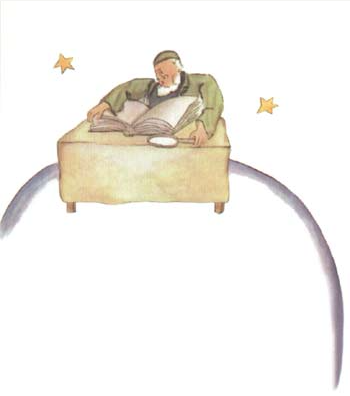 “Oh, look! Here is an explorer!” he exclaimed to himself when he saw the little prince coming.
The little prince sat down on the table and panted a little. He had already traveled so much and so far!
“Where do you come from?” the old gentleman said to him.
“What is that big book?” said the little prince. “What are you doing?”
“I am a geographer,” the old gentleman said to him.
“What is a geographer?” asked the little prince.
“A geographer is a scholar who knows the location of all the seas, rivers, towns, mountains, and deserts.”
“That is very interesting,” said the little prince. “Here at last is a man who has a real profession!” And he cast a look around him at the planet of the geographer. It was the most magnificent and stately planet that he had ever seen.
“Your planet is very beautiful,” he said. “Has it any oceans?”
“I couldn’t tell you,” said the geographer.
“Ah!” The little prince was disappointed. “Has it any mountains?”
“I couldn’t tell you,” said the geographer.
“And towns, and rivers, and deserts?”
“I couldn’t tell you that, either.”
“But you are a geographer!”
“Exactly,” the geographer said. “But I am not an explorer. I haven’t a single explorer on my planet. It is not the geographer who goes out to count the towns, the rivers, the mountains, the seas, the oceans, and the deserts. The geographer is much too important to go loafing about. He does not leave his desk. But he receives the explorers in his study. He asks them questions, and he notes down what they recall of their travels. And if the recollections of any one among them seem interesting to him, the geographer orders an inquiry into that explorer’s moral character.”
“Why is that?”
“Because an explorer who told lies would bring disaster on the books of the geographer. So would an explorer who drank too much.”
“Why is that?” asked the little prince.
“Because intoxicated men see double. Then the geographer would note down two mountains in a place where there was only one.”
“I know some one,” said the little prince, “who would make a bad explorer.”
“That is possible. Then, when the moral character of the explorer is shown to be good, an inquiry is ordered into his discovery.”
“One goes to see it?”
“No. That would be too complicated. But one requires the explorer to furnish proofs. For example, if the discovery in question is that of a large mountain, one requires that large stones be brought back from it.”
The geographer was suddenly stirred to excitement.
“But you– you come from far away! You are an explorer! You shall describe your planet to me!”
And, having opened his big register, the geographer sharpened his pencil. The recitals of explorers are put down first in pencil. One waits until the explorer has furnished proofs, before putting them down in ink.
“Well?” said the geographer expectantly.
“Oh, where I live,” said the little prince, “it is not very interesting. It is all so small. I have three volcanoes. Two volcanoes are active and the other is extinct. But one never knows.”
“One never knows,” said the geographer.
“I have also a flower.”
“We do not record flowers,” said the geographer.
“Why is that? The flower is the most beautiful thing on my planet!”
“We do not record them,” said the geographer, “because they are ephemeral.”
“What does that mean– ‘ephemeral’?”
“Geographies,” said the geographer, “are the books which, of all books, are most concerned with matters of consequence. They never become old-fashioned. It is very rarely that a mountain changes its position. It is very rarely that an ocean empties itself of its waters. We write of eternal things.”
“But extinct volcanoes may come to life again,” the little prince interrupted. “What does that mean– ‘ephemeral’?”
“Whether volcanoes are extinct or alive, it comes to the same thing for us,” said the geographer. “The thing that matters to us is the mountain. It does not change.”
“But what does that mean– ‘ephemeral’?” repeated the little prince, who never in his life had let go of a question, once he had asked it.
“It means, ‘which is in danger of speedy disappearance.’”
“Is my flower in danger of speedy disappearance?”
“Certainly it is.”
“My flower is ephemeral,” the little prince said to himself, “and she has only four thorns to defend herself against the world. And I have left her on my planet, all alone!”
That was his first moment of regret. But he took courage once more.
“What place would you advise me to visit now?” he asked.
“The planet Earth,” replied the geographer. “It has a good reputation.”
And the little prince went away, thinking of his flower.
中文
小王子拜访了一位地理学家
第六颗星球比刚才那颗大十倍。上面住着一位老先生,他正忙着写一大堆厚厚的书 。
“这非常有意思,”小王子说,“这儿终于有个有正当职业的人了!”他在地理学家的星球上四处打量。这是他见过的最壮丽、最宏伟的一颗星球。
“您的星球真美,”他说,“这儿有海洋吗?”
“我没法告诉你,”地理学家说。
“啊!”小王子很失望。“那有山脉吗?”
“我没法告诉你,”地理学家说。
“那有城市、河流和沙漠吗?”
“我也没法告诉你。”
“可您是一位地理学家呀!”
“没错,”地理学家说,“但我不是探险家。我的星球上一名探险家也没有。地理学家是不出去统计城市、河流、山脉、海洋和沙漠的。地理学家太重要了,不能到处闲逛。他从不离开书桌。但他要在办公室里接待探险家,询问他们,并记录下他们对旅途的回忆。如果其中某人的回忆让他觉得有意思,地理学家就会对这名探险家的品行展开调查。”
“这是为什么呢?”
“因为一个撒谎的探险家会给地理学著作带来灾难。同样,一个嗜酒如命的探险家也会如此。”
“这又是为什么?”小王子问。
“因为醉鬼看东西都是重影的。那样的话,地理学家就会在只有一个山头的地方记下两座山。”
“我认识一个人,”小王子说,“他当探险家肯定不合格。”
“这完全可能。那么,如果探险家的品行被证明是良好的,就会对他发现的事物展开调查。”
“是去实地考察吗?”
“不。那太复杂了。但我们会要求探险家提供证据。比如,如果发现的是一座大山,就要求他带回几块大石头。”
地理学家突然激动起来。
“而你——你从远方来!你是个探险家!你得给我描述一下你的星球!”
地理学家打开他的大登记簿,削好了铅笔。探险家的叙述先用铅笔记录下来。等到探险家提供了证据,再用钢笔正式誊写。
“那么,开始吧?”地理学家满怀期待地问。
“噢,我住的地方,”小王子说,“没什么意思。那儿非常小。我有三座火山,两座是活火山,一座是死火山。但谁也说不准以后会怎样。”
“谁也说不准,”地理学家重复道。
“我还有一朵花。”
“我们不记录花朵,”地理学家说。
“为什么?花可是我的星球上最美的东西!”
“我们不记录它们,”地理学家说,“因为它们是朝生暮死的。”
“‘朝生暮死’是什么意思?”
“地理书籍,”地理学家说,“是所有书籍中最严肃、最正经的。它们永远不会过时。一座山脉变换位置的情况极罕见,一个大洋的海水流尽的情况也极罕见。我们记录的是永恒的事物。”
“但死火山也可能会复活啊,”小王子打断道,“‘朝生暮死’到底是什么意思?”
“火山是死是活,对我们来说都一样,”地理学家说,“对我们来说,重要的是山本身。它是不会改变的。”
“但‘朝生暮死’到底是什么意思?”小王子追问道。他这一辈子只要提出了一个问题,就非要问个水落石出不可。
“它的意思是:‘面临很快就会消失的危险’。”
“我的花面临很快就会消失的危险吗?”
“那是肯定的。”
“我的花是朝生暮死的,”小王子自言自语道,“而且她只有四根刺来保护自己,对抗整个世界!而我却把她独自留在我的星球上!”
这是他第一次感到后悔。但他重新振作了精神。
“您建议我现在去访问什么地方呢?”他问。
“地球,”地理学家回答道,“那颗星球名声不错。”
于是,小王子离开了,心里牵挂着他的那朵花。
一部分内容摘录自《小王子》。 如有侵权, 请联系作者删除